
Purpose
Use recorded RTSM information for permitted review without treating an ordinary downloaded report as a signed regulatory copy.
Expected outcome
You can find a report, apply supported filters and understand the access/availability boundaries before exporting.
Prerequisites
A selected study, report-specific permissions and permitted site scope. CSV, JSON and PDF downloads additionally require Data.Export. Treatment content depends on blinding access.
Section 1: Find and preview a report
- Open Reports and browse the five-domain catalog.
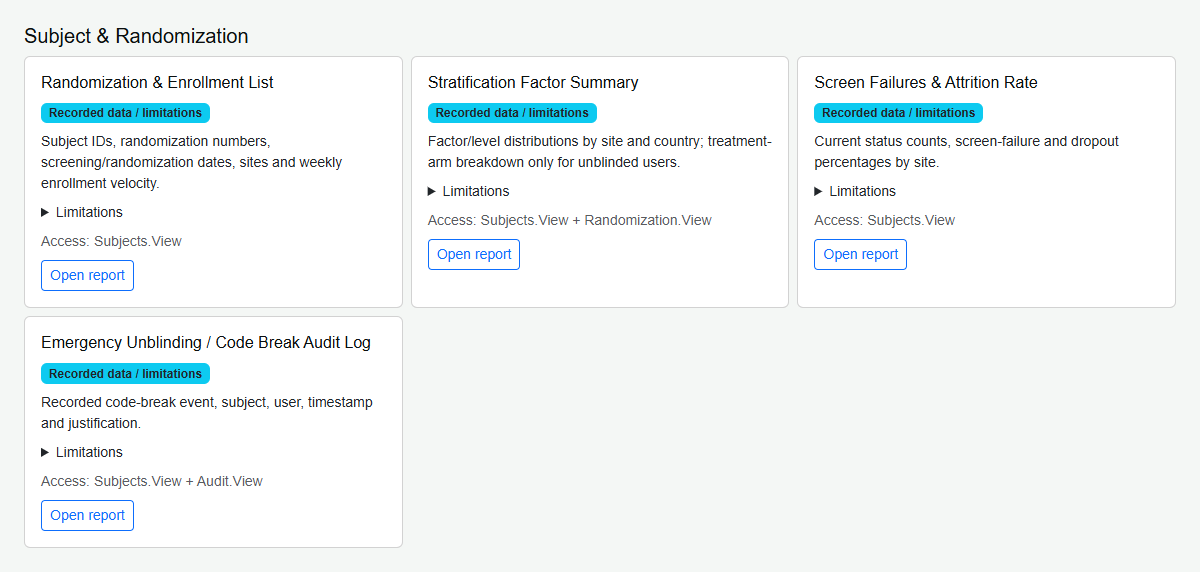
- Read the report description, availability badge and Limitations.
- Open an available report.
- Apply the supported site and UTC date filters, then generate the preview.
- Review scope, generation timestamp, notes, total rows and pagination before drawing conclusions.
A Not implemented entry is not a functioning report; it documents a capability boundary.
Section 2: Export the filtered scope
- CSV: spreadsheet-readable data, not a native Excel workbook.
- JSON: structured report output for permitted downstream use.
- PDF: review copy with scope/limitations, not a digital signature or audit lock.
- Export all filtered rows is distinct from the current preview page.
Protect the download according to its study, site and unblinded sensitivity. Do not attach confidential exports to public help articles.
Section 3: Distinguish retained documents
The Account-document store and immutable packaging-mapping output are separate workflows. Their retention/history controls must not be inferred for every PDF generated by the reporting page.
Troubleshooting and checks
No rows can mean filters exclude data, no recorded events exist or access is restricted. Missing export controls can mean Data.Export is absent. Preserve the report's limitations when sharing conclusions; it is not evidence that unimplemented automation exists.
This guide supports training and does not authorize clinical decisions, override access controls or establish regulatory compliance. The approved protocol and organizational procedures remain authoritative.